
Stocks, Bonds, and Funds: Understanding the Building Blocks of a Portfolio

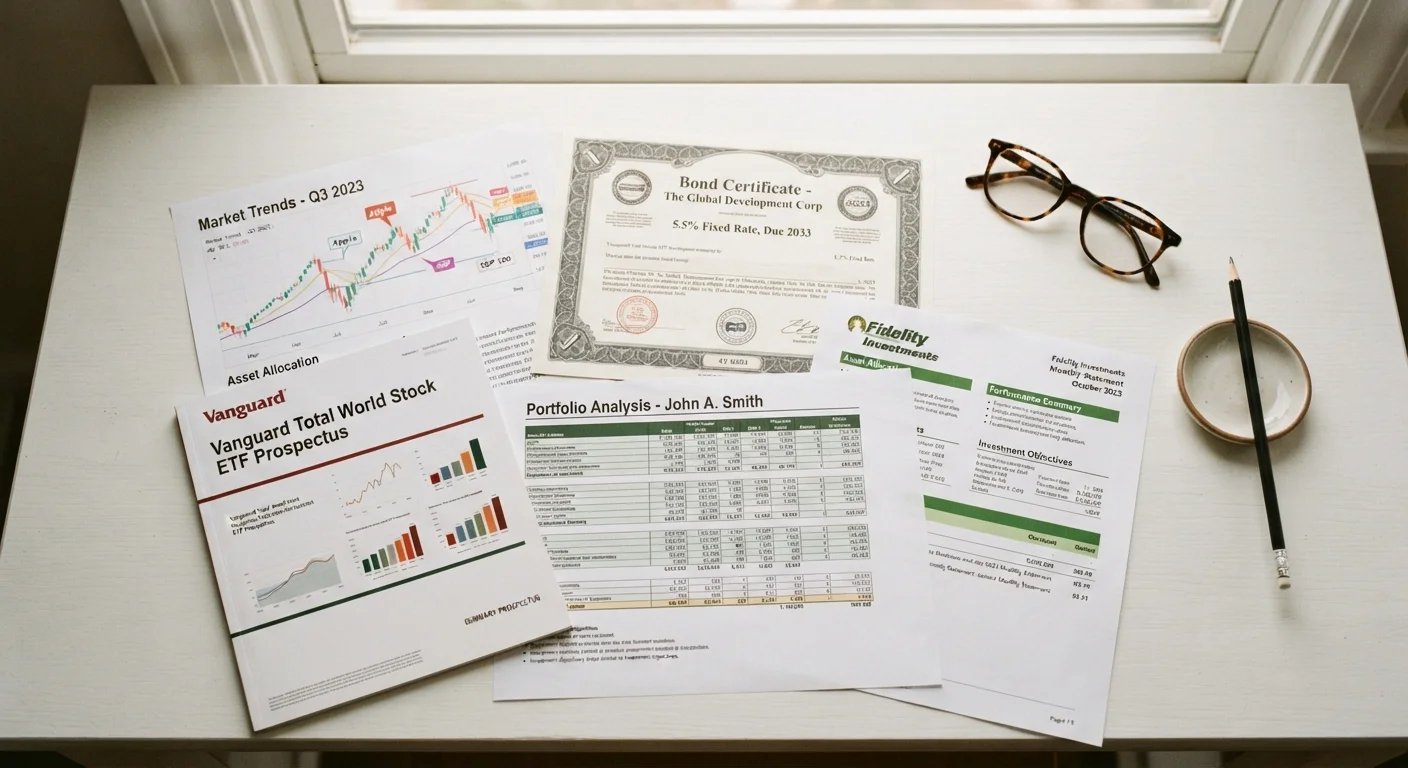
Photo: Online-Searches.net | Explore Insightful Blogs editorial
Why These Three Asset Types Matter
When financial professionals talk about building a portfolio, they're almost always referring to some combination of three core investment types: stocks, bonds, and funds. Each one works differently, carries a distinct level of risk, and plays a specific role in helping investors reach long-term goals.
Understanding what these assets actually represent — not just their names — is the first step toward feeling confident as an investor. You don't need a finance degree to get started. What you need is a clear mental model of how each building block behaves and why it's included in a portfolio. See our plain-English investing glossary for definitions of additional terms you may encounter along the way.
| What a stock represents | Partial ownership (equity) in a company |
| What a bond represents | A loan to a government or corporation in exchange for interest |
| What a fund provides | Pooled, diversified exposure to many securities at once |
| Risk level (general) | Stocks (higher) → Funds (varies) → Bonds (generally lower) (Risk levels are generalizations; actual risk depends on specific securities and market conditions.) |
| Typical role of bonds in a portfolio | Income generation and stability |
| Typical role of stocks in a portfolio | Long-term growth potential |
| Key cost to compare in funds | Expense ratio (annual % of assets) |
| ETF vs. mutual fund pricing | ETFs trade intraday; mutual funds priced once daily at market close |
Stocks: Owning a Piece of a Company
A stock (also called a share or equity) represents partial ownership in a company. When you buy stock in a company, you become a shareholder — entitled to a proportional claim on its assets and, in many cases, its profits distributed as dividends.
Stocks have historically delivered stronger long-term growth than most other asset types, but that potential comes with meaningful volatility. A company's stock price can rise or fall sharply based on earnings reports, economic conditions, or investor sentiment — sometimes in a single day. This makes stocks better suited to longer time horizons, where short-term price swings have time to smooth out.
Stocks are generally categorized by company size (large-cap, mid-cap, small-cap), by sector (technology, healthcare, energy), or by investment style (growth stocks vs. value stocks). Each category carries its own risk-return profile.
Stock (Equity)
A security representing partial ownership in a company. Stockholders may benefit from price appreciation and, in some cases, dividend payments, but also bear the risk of loss if the company underperforms.
Bond
A debt instrument in which an investor lends money to a borrower (such as a corporation or government) for a defined period at a fixed or variable interest rate. The borrower agrees to repay the principal at maturity.
Mutual Fund
A pooled investment vehicle that collects money from multiple investors to purchase a diversified portfolio of securities. Managed by a professional portfolio manager, it is priced once per trading day.
ETF (Exchange-Traded Fund)
A type of fund that trades on a stock exchange throughout the trading day. ETFs typically track a market index and tend to have lower expense ratios than actively managed mutual funds.
Expense Ratio
The annual percentage of a fund's assets charged to cover operating costs. A 0.10% expense ratio means you pay $1 per year for every $1,000 invested.
Asset Allocation
The strategy of dividing an investment portfolio among different asset categories — such as stocks, bonds, and cash — based on the investor's goals, risk tolerance, and time horizon.
Dividend
A portion of a company's earnings distributed to shareholders, usually on a quarterly basis. Not all companies pay dividends.
Diversification
The practice of spreading investments across different securities, sectors, or asset classes to reduce the impact of any single investment performing poorly.
Bonds: Lending Money in Exchange for Interest
A bond is a loan you make to a borrower — typically a corporation or government — in exchange for regular interest payments and the return of your original investment (called the principal) at a set future date known as the maturity date.
Because the income stream is predictable, bonds are often described as lower-risk than stocks. However, "lower risk" doesn't mean risk-free. Bond values fluctuate as interest rates change: when rates rise, existing bond prices generally fall, and vice versa. There's also credit risk — the possibility that the borrower defaults and cannot repay. U.S. Treasury bonds are widely regarded as among the safest bonds available because they are backed by the federal government, though no investment is entirely without risk.
In a diversified portfolio, bonds are frequently used to provide stability and income, helping offset the volatility of stock holdings.
Funds: Pooling Investments for Instant Diversification
A fund pools money from many investors to purchase a collection of securities — stocks, bonds, or both. Rather than picking individual companies or bonds, you buy shares of the fund and gain exposure to everything it holds.
The two most common fund types for individual investors are mutual funds and exchange-traded funds (ETFs). Mutual funds are priced once daily after markets close and are often actively managed by professional portfolio managers. ETFs trade throughout the day like individual stocks and are usually passively managed, meaning they track a market index such as the S&P 500 rather than trying to outperform it.
Funds are particularly useful for beginners because they provide built-in diversification — spreading risk across dozens or hundreds of securities — without requiring investors to research each one individually. Understanding how compound interest works can help you see why holding a diversified fund over a long period can be a powerful wealth-building approach.
Funds charge an annual expense ratio — a percentage of your assets deducted each year to cover operating costs. Even small differences in expense ratios can meaningfully affect long-term returns, so it's worth comparing them when evaluating similar funds.
How These Building Blocks Work Together
Most portfolios combine all three asset types in proportions that reflect the investor's goals, time horizon, and comfort with risk. A younger investor saving for retirement decades away might hold a higher percentage of stocks for growth potential. Someone approaching retirement might shift toward more bonds to preserve capital and generate income. Funds of either stocks or bonds can fill either role.
This mix is called your asset allocation, and it's one of the most consequential investment decisions you'll make. Research from financial economists has long suggested that asset allocation — not individual security selection — accounts for the majority of a portfolio's long-term return behavior.
Many workplace retirement plans, such as the 401(k), and individual retirement accounts like IRAs hold these same building blocks. If you want a deeper look at how those account types differ in tax treatment, our article on tax-advantaged accounts walks through the key distinctions.
This article is for general informational and educational purposes only and does not constitute personalized investment, tax, or legal advice. All investing involves risk, including the possible loss of principal. Past performance does not guarantee future results. Consult a qualified financial adviser before making investment decisions based on your individual circumstances.
The content provided on our blog site traverses numerous categories, offering readers valuable and practical information. Readers can use the editorial team’s research and data to gain more insights into their topics of interest. However, they are requested not to treat the articles as conclusive. The website team cannot be held responsible for differences in data or inaccuracies found across other platforms. Please also note that the site might also miss out on various schemes and offers available that the readers may find more beneficial than the ones we cover.