
Managing Savings and Debt Across Every Life Stage

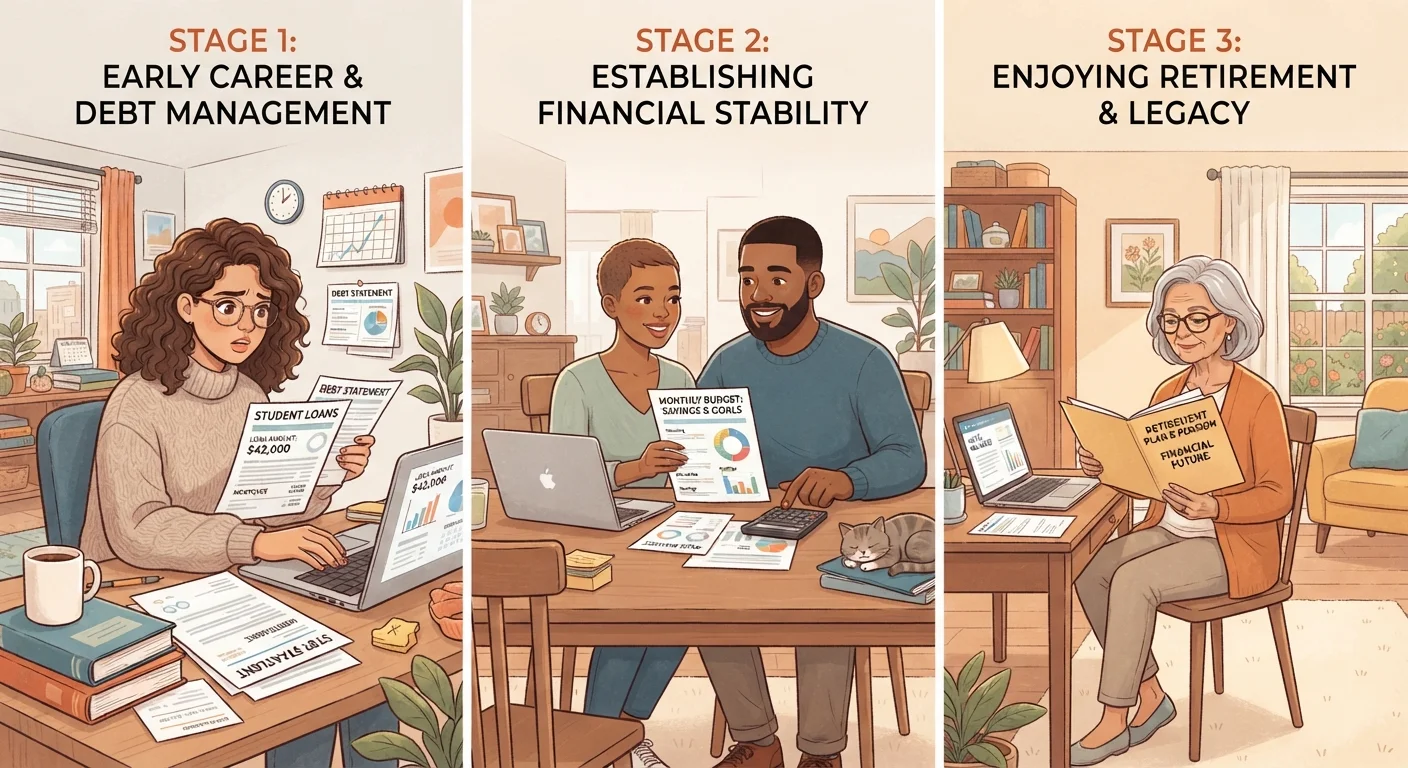
Photo: Online-Searches.net | Explore Insightful Blogs editorial
Key Takeaways
- Financial priorities shift naturally across life stages — no single strategy fits every age.
- Early adulthood should focus on emergency savings and high-interest debt elimination first.
- Mid-life typically means juggling mortgage debt, retirement contributions, and family expenses simultaneously.
- Pre-retirement is the time to reduce debt exposure and accelerate savings aggressively.
- An emergency fund, a clear debt payoff order, and consistent savings habits form the foundation at any age.
Why Financial Priorities Change Over Time
Managing money isn't a one-size-fits-all exercise. The strategies that make sense when you're 24 and carrying student loans look very different from the decisions you'll face at 45 with a mortgage, dependents, and a retirement timeline coming into focus. Life stages bring new income levels, new obligations, and new opportunities — and your financial plan needs to adapt accordingly.
This guide maps the key financial considerations across three major life phases: early adulthood, mid-life, and pre-retirement. If you're newer to these concepts, start with the fundamentals of saving and debt before diving in. The goal here is to help you understand what matters most at each stage — not to prescribe a specific plan, which should be shaped by a licensed financial professional who knows your situation.
28%
Americans with no emergency savings
According to Bankrate's annual emergency savings report, roughly one in four Americans have no emergency savings at all.
$1.77T
Total U.S. student loan debt outstanding
Federal Reserve data shows student loan debt remains one of the largest categories of household debt in the United States.
15%
Commonly cited retirement savings target
Many financial planning guidelines suggest saving 10–15% of gross income annually for retirement, though individual needs vary considerably.
Early Adulthood: Building the Foundation
The years roughly spanning your mid-twenties to mid-thirties often come with a mix of entry-level income, student loan balances, and very little savings cushion. The temptation is to tackle every financial goal at once. A more realistic approach focuses on sequencing.
Step 1: Build a starter emergency fund
Before aggressively paying down any debt, aim to set aside enough to cover one to three months of essential expenses. This buffer prevents a single unexpected bill from sending you deeper into debt. Even a modest amount — $500 to $1,000 — meaningfully reduces financial fragility.
Step 2: Eliminate high-interest debt
Credit card balances carrying double-digit interest rates drain your financial momentum faster than almost anything else. Prioritizing these — while making minimum payments on lower-rate debts like federal student loans — is generally the mathematically sound approach. See our framework for paying off debt while saving for a practical structure.
Step 3: Start retirement contributions early
Time in the market matters enormously due to compounding growth. Even small contributions to an employer-sponsored retirement plan — especially if an employer match is available — provide long-term value that's difficult to replicate by starting later. Missing a match is effectively leaving compensation on the table.
If your employer offers any retirement match, contribute at least enough to capture it before putting extra money toward lower-interest debt like federal student loans. The immediate guaranteed return from a match is hard to beat.
When building an emergency fund feels slow, automate a fixed transfer to savings on payday — even $25 a week. Consistency compounds faster than occasional large deposits.
Mid-Life: Balancing Competing Demands
Mid-life, roughly the late thirties through mid-fifties, often brings higher income — but also more financial complexity. A mortgage, children's education costs, aging parents, and retirement savings can all demand attention at the same time.
The key discipline here is resisting the urge to treat every goal as equally urgent. A useful order of priority:
- Maintain and expand your emergency fund to three to six months of expenses. Household income is more exposed to disruption — job loss, medical events — than in early adulthood.
- Avoid taking on high-interest consumer debt. If you're managing a mortgage, keep other debt low-rate and manageable.
- Accelerate retirement savings as income grows. Contribution limits for 401(k)s and IRAs tend to rise with IRS adjustments; maxing or approaching limits becomes more achievable at higher income levels.
- Approach college savings realistically. Tools like 529 plans can help, but not at the cost of your own retirement security. Financial advisers often note that children can borrow for college; retirees cannot borrow for retirement.
If you share finances with a partner, alignment matters as much as math. Navigating money conversations as a household can help couples get on the same page without ongoing conflict.
Pre-Retirement: Shifting the Balance Toward Security
The decade or so before retirement — typically the late fifties and early sixties — calls for a deliberate shift in strategy. This is the time to reduce financial exposure and build the highest savings rate your budget can sustain.
Priorities during this phase typically include:
- Eliminating or significantly reducing debt, especially the mortgage if possible. Entering retirement without major debt obligations reduces the income you need to draw from savings each month.
- Using catch-up contributions if available. The IRS allows workers 50 and older to contribute additional amounts to 401(k)s and IRAs beyond standard limits — a meaningful advantage for those who started saving late.
- Reviewing your savings rate critically. Understanding what percentage of income you're saving — and whether it's on track — is essential. Our guide to understanding your savings rate explains how to calculate and interpret this figure.
- Modeling income sources — Social Security, pensions if applicable, investment accounts — to understand how much you'll realistically need to draw each year.
Pre-Retirement Debt and Social Security Timing
Principles That Apply at Every Stage
Regardless of age or income level, a handful of financial behaviors remain consistently valuable:
- Know your numbers.
- Tracking monthly income, spending, and savings isn't optional — it's the mechanism that makes every other strategy work. Building a budget that accommodates both debt and savings gives you a starting framework.
- Sequence your priorities.
- Emergency fund before aggressive debt payoff. High-interest debt before low-rate debt. Employer match before additional savings. Order matters more than speed.
- Revisit your plan regularly.
- Income changes, family composition shifts, and markets move. A plan that fit two years ago may need adjustment today.
- Work with a qualified professional.
- A licensed financial planner or adviser can provide guidance specific to your tax situation, income, goals, and risk tolerance — something no general article can replicate.
This article is for general informational and educational purposes only and does not constitute personalized financial, investment, tax, or legal advice. Consult a qualified financial professional before making decisions specific to your circumstances.
The content provided on our blog site traverses numerous categories, offering readers valuable and practical information. Readers can use the editorial team’s research and data to gain more insights into their topics of interest. However, they are requested not to treat the articles as conclusive. The website team cannot be held responsible for differences in data or inaccuracies found across other platforms. Please also note that the site might also miss out on various schemes and offers available that the readers may find more beneficial than the ones we cover.