
Where Your First $1,000 in Savings Should Actually Sit

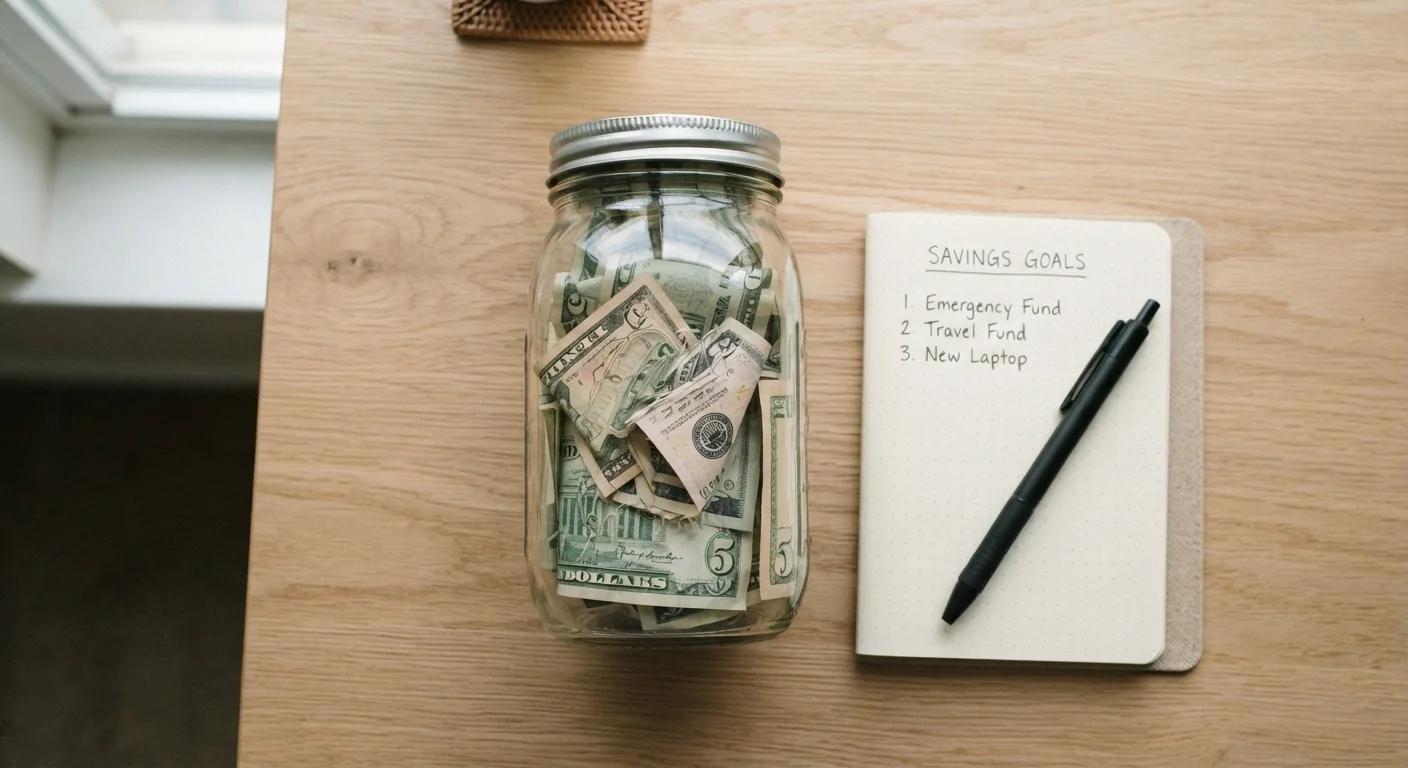
Photo: Online-Searches.net | Explore Insightful Blogs editorial
Key Takeaways
- Your first $1,000 in savings should be liquid, accessible, and protected from investment risk.
- High-yield savings accounts and money market accounts typically offer better returns than standard checking or savings accounts.
- Certificates of deposit lock up your money, making them a poor fit for an emergency fund.
- Keeping emergency savings separate from everyday spending reduces the temptation to dip into them.
- Even while paying off debt, a small cash cushion can prevent you from taking on new debt in a crisis.
Why the Account Type Actually Matters
Building your first $1,000 in savings is a meaningful milestone — but where you park that money shapes how useful it actually is when you need it. The wrong account can mean losing access during an emergency, earning nearly nothing in interest, or accidentally spending it before a real crisis hits.
Think of this $1,000 as a starter emergency fund: a cash buffer designed to absorb small financial shocks — a car repair, a medical copay, an unexpected utility spike — without forcing you onto a credit card. For context on how this fits into a broader financial readiness picture, see our guide on sizing an emergency fund.
The core criteria for evaluating any account to hold this money are: liquidity (can you access it quickly?), safety (is it FDIC- or NCUA-insured?), and yield (is it earning a reasonable return?). Each account type below scores differently on these three dimensions.
Comparing the Main Account Options
Four account types commonly come up when people consider where to keep a small emergency reserve. Here's how they compare across the criteria that matter most for a starter fund.
| Standard Savings | High-Yield Savings | Money Market Account | Certificate of Deposit | |
|---|---|---|---|---|
| Typical Interest Rate | Very low (often <0.5% APY) | Higher (rate varies, floats) | Moderate to high (floats) | Fixed for term, often competitive |
| Liquidity / Access | Easy, immediate | Easy, 1–3 day transfer | Easy, may include checks | Locked until maturity |
| Early Withdrawal Penalty | None | None | None | Yes — typically 60–150 days interest |
| FDIC / NCUA Insured | Yes | Yes | Yes | Yes |
| Best Fit For | Simple convenience | Earning yield while staying liquid | Yield plus limited check access | Extra savings, not emergency funds |
A few details worth unpacking:
- Standard savings accounts at large traditional banks often pay well below 1% APY, which means your $1,000 earns only a few dollars per year in interest.
- High-yield savings accounts (HYSAs), typically offered by online banks, have in recent periods offered significantly higher rates — though rates float with broader interest rate conditions and are not guaranteed to hold.
- Money market accounts (MMAs) function similarly to HYSAs but may include a debit card or limited check-writing, which can be useful or a temptation depending on your habits.
- Certificates of deposit (CDs) lock your money in for a fixed term. Early withdrawal usually triggers a penalty. That makes CDs a poor fit for funds you might need on short notice.
The Debt Payoff Tension: Do You Even Save First?
If you're carrying high-interest debt — particularly credit card balances — you might wonder whether saving $1,000 makes sense at all when the interest on that debt is accumulating daily. This is a genuine trade-off, not a simple answer.
The general logic many personal finance educators use: a small cash cushion prevents you from adding to your debt when something goes wrong. If you drain every dollar toward debt but then your car needs a repair, you'll likely reach for the credit card again — undoing progress. A $1,000 buffer breaks that cycle.
The $1,000 Rule of Thumb
Once you have that baseline reserve in place, the priority typically shifts: pay down high-interest debt aggressively before building savings beyond $1,000. Our budgeting starter guide can help you structure how much goes where each month.
Keeping It Separate — and Accessible
Behavioral research consistently shows that people spend money more easily when it's in the same account as their daily expenses. Opening a dedicated savings account — even at the same institution — reduces casual spending from that balance. If the account is at a different bank than your checking, a small transfer delay (typically one to three business days) adds a further friction that protects the fund without making it inaccessible in a real emergency.
Avoid putting your starter emergency fund in an investment account or brokerage, even a low-risk one. Markets fluctuate, and a fund designed for emergencies shouldn't be worth less the day you need it most. For a clear look at what comes after the emergency fund is in place, see our financial readiness checklist before moving toward investing.
This article is for general informational and educational purposes only and does not constitute personalized financial advice. Consult a qualified financial professional for guidance specific to your situation.
The content provided on our blog site traverses numerous categories, offering readers valuable and practical information. Readers can use the editorial team’s research and data to gain more insights into their topics of interest. However, they are requested not to treat the articles as conclusive. The website team cannot be held responsible for differences in data or inaccuracies found across other platforms. Please also note that the site might also miss out on various schemes and offers available that the readers may find more beneficial than the ones we cover.