
Japan vs. South Korea: Choosing Your First East Asia Trip

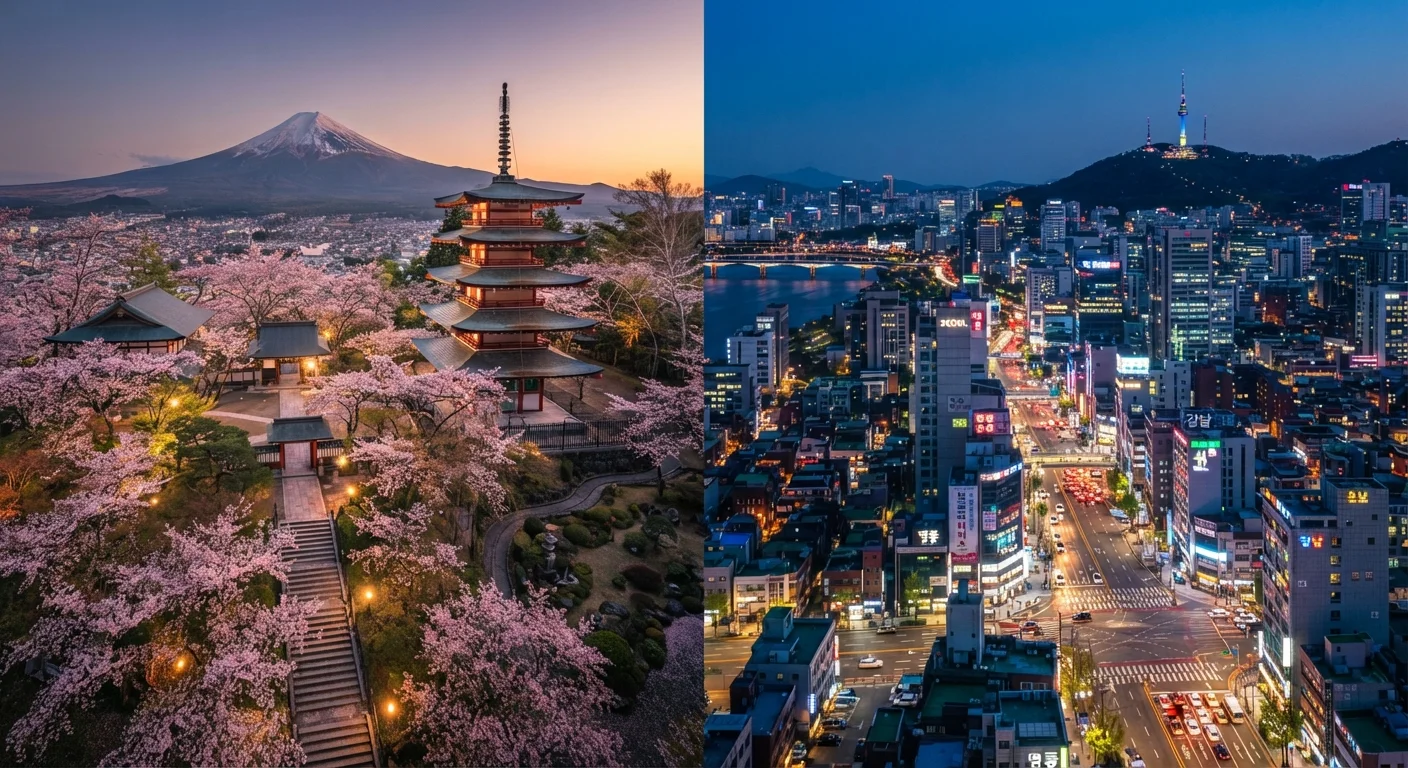
Photo: Online-Searches.net | Explore Insightful Blogs editorial
Key Takeaways
- Japan typically costs more per day than South Korea, but both remain accessible for budget-conscious travelers.
- South Korea's cities are highly compact, making it easier to cover more ground in fewer days.
- Japan's extensive rail network is legendary, while South Korea's metro systems are among the world's most user-friendly.
- Language barriers exist in both countries, but English signage is more widespread in South Korea's major cities.
- Both countries require no visa for most American travelers staying under 90 days — always verify entry rules before departure.
- Your travel style — slow and contemplative vs. fast and immersive — is often the deciding factor between the two.
Two Countries, Two Very Different Journeys
Choosing between Japan and South Korea for your first East Asia trip is genuinely exciting — and genuinely tricky. Both countries are safe, welcoming, and logistically straightforward by global standards. But they deliver very different emotional experiences. Japan moves at a measured, deliberate pace; South Korea crackles with energy. Understanding how those differences translate into practical travel decisions is exactly what this guide is for.
If you're just starting to map out your very first international adventure, our first international trip planning guide covers the foundational logistics — passports, booking timelines, and pre-departure prep — that apply no matter which destination you choose.
| Criterion | Japan | South Korea |
|---|---|---|
| Typical daily budget (mid-range) | ~$80–$130 | ~$60–$100 |
| Country size / ease of coverage | Larger; regional variety rewards longer stays | Compact; multiple cities easy in one trip |
| Long-distance transit | Shinkansen bullet train network | KTX high-speed rail |
| English signage | Good in cities; limited rurally | Very good in major urban areas |
| Street food culture | Rich but more restaurant-focused | Extremely vibrant and affordable |
| Cultural pace | Deliberate, contemplative | Fast-paced, energetic |
| US visa requirement | Visa-free up to 90 days (verify before travel) | Visa-free up to 90 days (verify before travel) |
Cost and Daily Budget: What to Realistically Expect
Japan has a reputation for being expensive, but much of that perception is outdated or overstated. Yes, a ryokan (traditional inn) stay or a Michelin-starred omakase dinner will cost you — but convenience stores stock excellent, filling meals for under $5, and budget guesthouses are plentiful. A realistic mid-range daily budget in Japan runs roughly $80–$130, factoring in accommodation, food, and local transport.
South Korea generally comes in lower. Seoul's street food scene is legendary for affordability — tteokbokki, kimbap, and sundubu-jjigae can fuel a full day for a remarkably small outlay. Mid-range travelers often find $60–$100 per day comfortable. Accommodation in both countries ranges from capsule hotels and guesthouses to boutique stays, giving you meaningful control over your spend.
~3 hrs
Seoul to Busan by KTX high-speed rail
South Korea's KTX connects its two largest cities in under three hours, making multi-city itineraries very manageable.
~320 km/h
Top speed of Japan's Shinkansen
Japan's bullet train network is one of the fastest and most punctual rail systems anywhere in the world.
30M+
Annual international visitors to Japan (pre-pandemic peak)
Japan has consistently ranked among the world's most-visited countries, reflecting its strong infrastructure for international travelers.
Getting Around: Transit, Trains, and Navigation
Japan's Shinkansen bullet train network is one of the most celebrated transit systems on earth — connecting Tokyo, Kyoto, Osaka, and beyond with clockwork precision. For multi-city trips, a Japan Rail Pass can offer solid value (calculate your routes before purchasing to confirm it works for your itinerary). Within cities, IC cards like Suica or Pasmo make hopping between subway, bus, and even convenience stores frictionless.
South Korea's transit wins on simplicity and cost. The Seoul Metro is one of the most navigable in the world, with English, Chinese, and Japanese signage throughout. The T-money card works nationwide across buses and trains. Korea Train eXpress (KTX) connects Seoul to Busan in under three hours. For first-timers, South Korea's compactness is a genuine advantage — you're never far from the next experience.
Entry Requirements Change — Always Verify
Culture, Pace, and What Kind of Traveler You Are
Japan rewards slowness. Spending an afternoon in a single Kyoto garden, joining a tea ceremony, or wandering Nara's deer-filled park offers a contemplative depth that rushes feel sacrilegious. The culture of omotenashi — selfless hospitality — permeates service interactions, making even small moments feel considered.
South Korea rewards curiosity and spontaneity. Seoul's neighborhoods — Hongdae, Insadong, Bukchon — shift personalities block by block. K-pop culture, vibrant nightlife, and cutting-edge fashion coexist with centuries-old palaces. Interactions tend to feel more immediately energetic. If you're comparing your East Asia options to a first European trip, our piece on choosing a European city for a first overseas trip uses a similar framework — cultural pace and accessibility often matter more than geography alone.
Neither approach is better. The question is which one matches your rhythm.
The content provided on our blog site traverses numerous categories, offering readers valuable and practical information. Readers can use the editorial team’s research and data to gain more insights into their topics of interest. However, they are requested not to treat the articles as conclusive. The website team cannot be held responsible for differences in data or inaccuracies found across other platforms. Please also note that the site might also miss out on various schemes and offers available that the readers may find more beneficial than the ones we cover.