
Liability-Only vs. Full Coverage: When Each One Makes Financial Sense

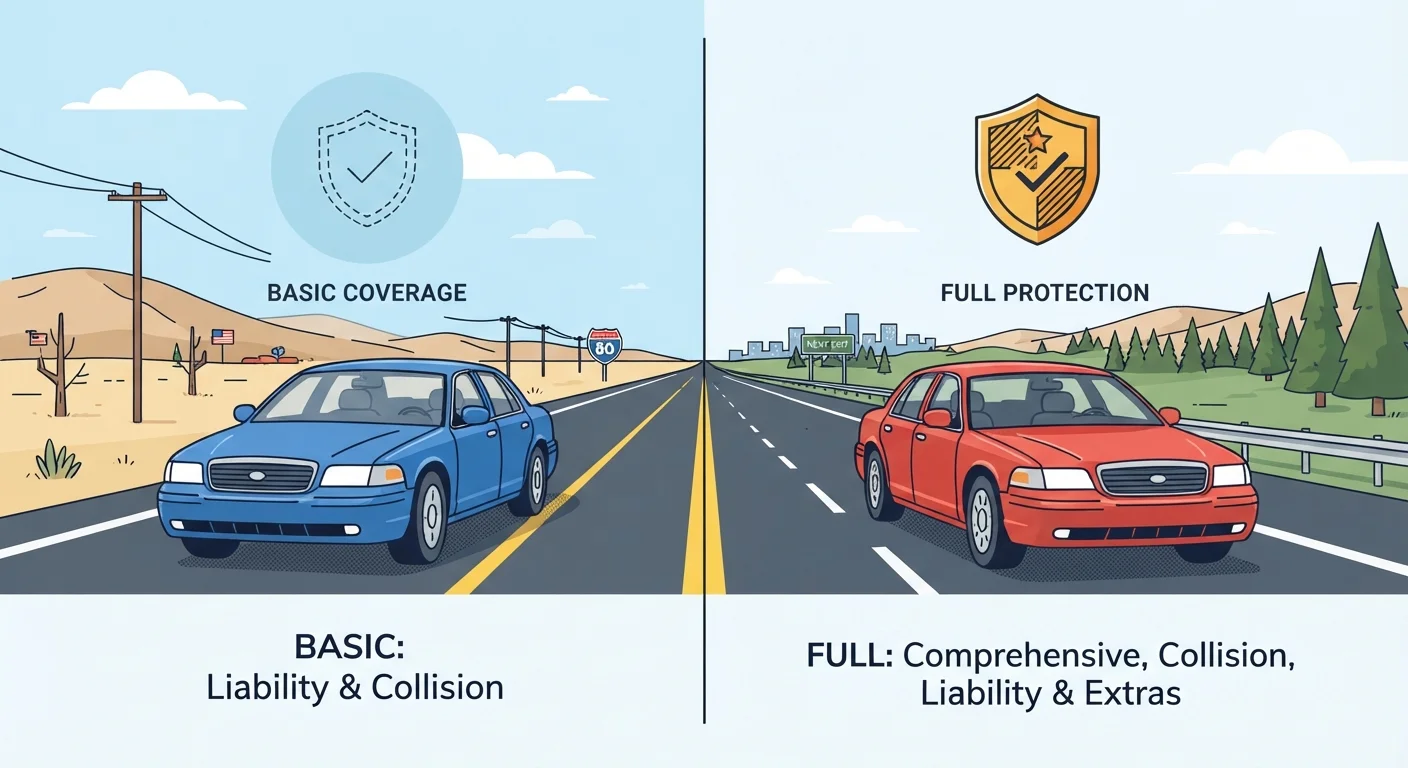
Photo: Online-Searches.net | Explore Insightful Blogs editorial
Key Takeaways
- Liability-only meets most state legal minimums but leaves your own vehicle unprotected after a crash.
- Full coverage adds collision and comprehensive protection, which lenders typically require on financed vehicles.
- The right choice depends on your car's current market value, your savings cushion, and your risk tolerance.
- A general rule of thumb: if your annual premium exceeds 10% of your car's value, liability-only may be worth considering.
- State minimum liability limits can be surprisingly low — raising them is often worth the modest additional cost.
What These Two Coverage Levels Actually Mean
Before comparing them, it's worth understanding precisely what each term covers — because the industry labels can mislead. For a deeper breakdown of every standard policy component, see our Car Insurance Explained guide.
Liability-only coverage pays for damage and injuries you cause to other people in an accident where you're at fault. It does not pay for your own vehicle's repairs or your own medical bills. Most U.S. states set a legal minimum level of liability coverage that every registered driver must carry, though those minimums vary considerably from state to state and are often lower than the real-world cost of a serious accident.
Full coverage is an informal term — not an official policy type — that describes a liability policy plus two additional protections: collision (repairs to your car after an accident, regardless of fault) and comprehensive (repairs or replacement for non-collision events such as theft, fire, flooding, hail, and animal strikes). Together, these three layers address a much wider range of scenarios.
| Criterion | Liability-Only | Full Coverage |
|---|---|---|
| Covers damage to others | Yes | Yes |
| Covers your own vehicle (collision) | No | Yes |
| Covers theft, weather, fire | No | Yes (comprehensive) |
| Required by lenders/lessors | No | Yes |
| Meets state legal minimum | Yes (if at state minimums) | Yes |
| Typical monthly premium | Lower | Higher |
| Best suited for vehicle value | Lower-value, older vehicles | Newer or higher-value vehicles |
The Financial Logic Behind Each Choice
The decision between these two coverage levels is fundamentally a financial calculation, not just a preference. The core question: can you afford to repair or replace your own vehicle if it's damaged or destroyed?
A commonly cited rule of thumb among personal finance educators is to reconsider full coverage when your combined annual collision and comprehensive premium exceeds roughly 10% of your vehicle's current market value. At that point, you're paying a significant fraction of the car's worth each year for coverage whose maximum payout is limited to the car's depreciated value anyway.
~13%
U.S. drivers estimated uninsured
The Insurance Research Council has estimated that roughly 1 in 8 U.S. drivers carries no insurance, underscoring why liability limits — and uninsured motorist coverage — deserve attention.
$4,711
Average collision claim payout
According to the Insurance Information Institute, the average collision claim has historically been in the multi-thousand-dollar range, illustrating the potential out-of-pocket exposure under liability-only coverage.
47 states
States requiring liability insurance
Nearly all U.S. states mandate some form of liability auto insurance, though minimum required limits differ significantly across jurisdictions.
On the other hand, liability limits matter more than many drivers realize. State minimums — sometimes as low as $15,000 per person for bodily injury — can be exhausted quickly in a multi-vehicle accident involving injuries, leaving you personally responsible for the remainder. Raising liability limits is usually one of the more cost-effective upgrades available on any policy.
Financing changes the equation entirely. As explained in our article on financing versus paying cash, lenders have a financial stake in your vehicle and require collision and comprehensive coverage to protect that collateral — so full coverage isn't optional until the loan is satisfied.
When to Reassess and How to Think Long-Term
Coverage needs aren't static. As a vehicle ages and depreciates, the financial case for full coverage weakens — and this is worth revisiting periodically rather than letting your policy auto-renew without review. Our guide on keeping insurance costs manageable over time outlines practical approaches to this kind of regular policy reassessment.
A few factors worth weighing when you revisit coverage:
- Current vehicle value: Use widely available valuation tools to check your car's approximate market value annually.
- Your deductible: A higher deductible on collision and comprehensive lowers your premium, but you'll need to cover that amount out of pocket after a claim. Make sure your savings can absorb it.
- Your driving environment: Frequent highway driving, severe weather regions, or high-theft urban areas all shift the risk calculation toward broader coverage.
- Your savings cushion: Carrying liability-only only makes sense if you genuinely could handle an unexpected repair or total loss without serious financial hardship.
There's no universally correct answer — but approaching it as a deliberate financial decision, rather than defaulting to whatever coverage you've always carried, tends to serve drivers better over the long run.
This article is for general informational purposes only and does not constitute personalized financial, insurance, or legal advice. Coverage requirements vary by state. Consult a licensed insurance professional for guidance specific to your circumstances.
The content provided on our blog site traverses numerous categories, offering readers valuable and practical information. Readers can use the editorial team’s research and data to gain more insights into their topics of interest. However, they are requested not to treat the articles as conclusive. The website team cannot be held responsible for differences in data or inaccuracies found across other platforms. Please also note that the site might also miss out on various schemes and offers available that the readers may find more beneficial than the ones we cover.