
Blind Spots, Mirrors, and the Geometry of What You Can't See

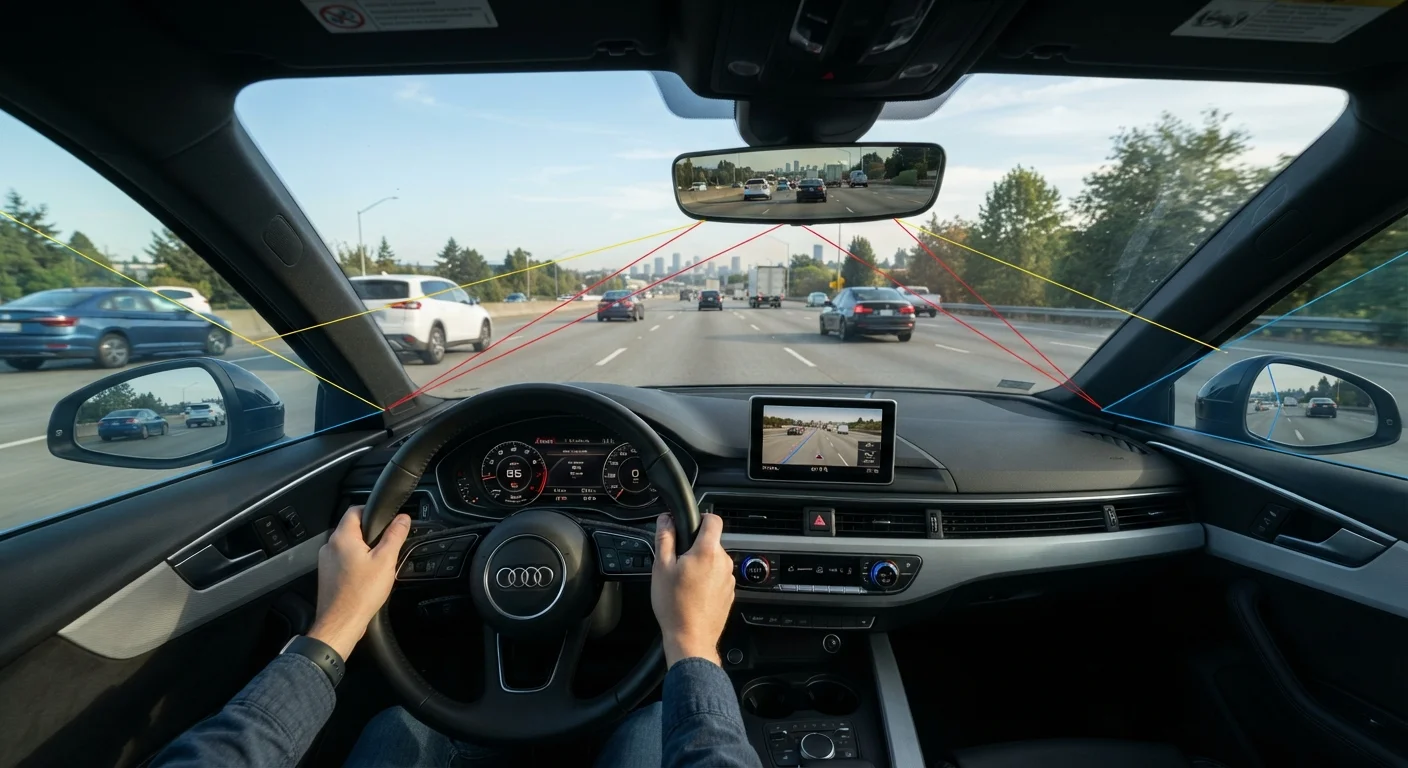
Photo: Online-Searches.net | Explore Insightful Blogs editorial
Key Takeaways
- Most drivers position side mirrors too far inward, creating unnecessary overlap with the rearview mirror.
- Blind spots are a product of geometry — understanding them helps you adjust mirrors to minimize hidden zones.
- The BGE (Blind Spot Elimination) method positions side mirrors outward enough to nearly eliminate classic blind spots.
- No mirror setup removes the need for a head-check before changing lanes.
- Adjusting mirrors from the driver's seat in your normal seating position is essential for accuracy.
Why Blind Spots Exist — and Why They're Bigger Than You Think
A blind spot is simply any area around your vehicle that your mirrors and peripheral vision don't cover simultaneously. Every car has them. The shape and size of those hidden zones depend on three factors: the geometry of your vehicle's body, the size and angle of your mirrors, and where you sit relative to both.
Most drivers were taught to set their side mirrors so they can just see the rear corner of their own car. That feels intuitive — it gives a visual anchor — but it creates a significant problem: that corner of your car is already visible to you without a mirror. The overlap wastes usable coverage. The real danger zone sits further outward, in the space alongside your rear quarter panels where a motorcycle or compact car can hide entirely from view.
The classic blind spot on a typical sedan sits roughly between the B-pillar (the post between your front and rear door windows) and the edge of your side mirror's field of view. For many vehicles, this zone is large enough to conceal a full-size pickup truck at highway speeds — a sobering fact that underscores how much mirror angle matters.
For a deeper look at how reduced visibility compounds driving risk in other contexts, see our article on why night driving is harder than most people realize.
How to Set Your Mirrors the Right Way
The following steps walk through the Blind Spot Elimination (BGE) method, a widely referenced approach among driving safety educators. It won't make your blind spots disappear entirely, but it dramatically reduces them by using each mirror for the zone it's best suited to cover.
What you will need
Sit in your normal driving position
Before touching any mirror, sit exactly as you would while driving — seat adjusted, back against the seat back, hands where they'd naturally rest. Mirror angles set while you're leaning in or slouching will be wrong the moment you sit up normally.
Set the rearview mirror first
Center the rearview mirror so the entire rear window is visible with minimal head movement. This mirror covers the direct zone behind you and serves as your baseline reference for what the side mirrors need to pick up from there outward.
Adjust the driver's side mirror outward
Lean your head until it nearly touches the driver's window glass. From that position, adjust the left side mirror until you can just barely see the rear corner of your own car at the inner edge of the mirror's view. When you return to normal seated position, your car's flank should no longer be visible — only the lane beside you.
Adjust the passenger's side mirror outward
Lean your head to the center of the car — toward the rearview mirror — and adjust the right side mirror until you can just barely see the passenger-side rear corner at the inner edge. Return to normal position: again, your car should largely disappear from that mirror's view, replaced by the adjacent lane.
Verify coverage by doing a slow mental sweep
Check the rearview mirror, then glide your eyes to the driver's side mirror, then the passenger's side mirror. A vehicle passing behind you should transition smoothly from one mirror to the next with minimal gap. If it disappears briefly between the rearview and a side mirror, angle the side mirror slightly inward to close that gap.
Re-check Your Mirror Setup Seasonally
What Mirrors Still Can't Do
Even optimally positioned mirrors have limits. Objects moving very quickly from behind — such as motorcycles accelerating in adjacent lanes — can enter and exit a blind zone faster than a mirror check catches them. Pillars, headrests, and passengers can also create secondary blind spots independent of your mirrors entirely.
This is why a quick head-check (a brief glance over your shoulder toward the lane you're entering) remains non-negotiable before any lane change, regardless of mirror setup. Mirrors give you a continuous passive scan; the head-check gives you a targeted, active confirmation.
Mirrors Alone Are Never Sufficient
Blind spot monitoring systems, now common on many newer vehicles, use radar sensors to alert you when a vehicle enters the zone your mirrors don't cover. These systems are useful supplements — but they're designed to back up good mirror habits, not replace them. Over-reliance on any single system creates its own risk.
Lane changes are also one of the most frequently mishandled highway maneuvers. Our breakdown of common merging mistakes on the highway pairs well with the habits you're building here.
If you're a new car owner still getting comfortable with your vehicle's layout, it's worth checking what new car owners most commonly overlook in the first six months — mirror setup often doesn't make the list, but it should.
The content provided on our blog site traverses numerous categories, offering readers valuable and practical information. Readers can use the editorial team’s research and data to gain more insights into their topics of interest. However, they are requested not to treat the articles as conclusive. The website team cannot be held responsible for differences in data or inaccuracies found across other platforms. Please also note that the site might also miss out on various schemes and offers available that the readers may find more beneficial than the ones we cover.