
Night Driving Is Harder Than You Think — Here's Why

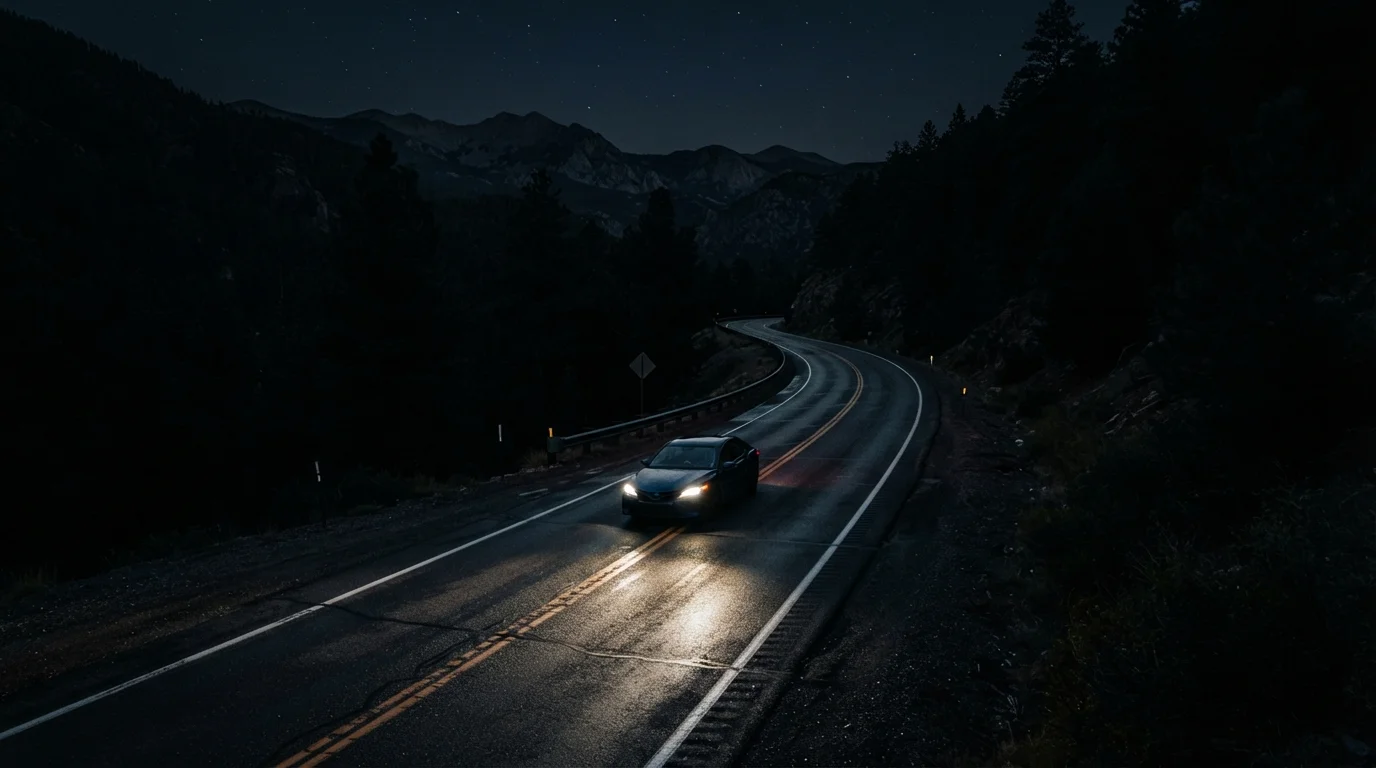
Photo: Online-Searches.net | Explore Insightful Blogs editorial
Key Takeaways
- Nighttime accounts for roughly half of all traffic fatalities despite far fewer vehicle miles traveled after dark.
- Your eyes take up to 30 minutes to fully adapt to darkness after bright light exposure.
- Glare from oncoming headlights can temporarily reduce visibility far beyond what most drivers anticipate.
- Fatigue and night driving are closely linked because darkness triggers the brain's sleep-onset mechanisms.
- Reduced visibility shrinks your stopping margin — you may be traveling faster than your headlights allow you to safely stop.
The Numbers Behind the Danger
Most drivers assume nighttime roads are safer simply because there is less traffic. That intuition is wrong. According to the National Highway Traffic Safety Administration (NHTSA), a disproportionate share of traffic fatalities occur between dusk and dawn, even though nighttime vehicle miles traveled are a fraction of daytime totals. The fatal crash rate per mile driven is significantly higher after dark.
Understanding why this happens requires looking at what darkness actually does to the human body and to the physics of stopping a vehicle.
~50%
Of traffic fatalities occur at night
NHTSA data consistently shows nighttime hours account for a disproportionate share of fatal crashes relative to traffic volume.
30 min
Time for full dark adaptation
Vision researchers estimate complete rod-based dark adaptation takes 20–30 minutes after bright light exposure.
90 ft
Distance traveled during one second of glare blindness at 60 mph
At highway speeds, even a brief glare recovery period covers enough road to miss a stationary obstacle entirely.
What Darkness Does to Your Vision
Human vision evolved for daylight. The eye uses two types of photoreceptors: cones for color and detail in bright conditions, and rods for low-light perception. At night, rods take over — but they are slower to respond, cannot distinguish color well, and provide lower resolution overall. The result is a vision system that is operating well below its daytime capacity.
Dark adaptation — the process your eyes go through when moving from bright to dim light — takes a surprisingly long time. While your pupils dilate within seconds, the chemical changes needed for full rod sensitivity can take 20 to 30 minutes. Glancing at your phone or being hit by oncoming high beams can interrupt that process and force a partial reset.
Depth perception and peripheral vision also degrade at night, making it harder to judge the speed of approaching vehicles or spot hazards at the edge of your path. For more on visual blind zones, see how blind spots and mirror geometry work.
Glare: The Hidden Hazard
Modern headlights are brighter than ever — which is good for the driver using them, but can create intense glare for everyone else on the road. Glare temporarily overwhelms the retina, producing a recovery period called glare recovery time. For younger drivers this may last a second or two. For drivers over 50, it can stretch noticeably longer.
The danger is that a second of blindness at 60 mph covers roughly 90 feet of road. During glare recovery, any obstacle — a stopped vehicle, a pedestrian, an animal — is effectively invisible.
Protect Your Night Vision Inside the Car
Fatigue and the Body Clock
Darkness is a biological signal. Your body's circadian rhythm responds to the absence of light by releasing melatonin and preparing for sleep. This means that nighttime driving is fought against your own physiology — attention naturally narrows, reaction times lengthen, and microsleeps (brief, involuntary lapses in consciousness) become more likely.
Fatigue-related impairment is especially insidious because it tends to be self-concealed. Tired drivers often feel capable and alert right up until they aren't. For a deeper look at the warning signs, see our guide on driving fatigue warning signs most people miss.
Overdriving Your Headlights
Even with functioning headlights, most drivers unknowingly create a mismatch between their speed and their actual stopping distance. Standard low-beam headlights illuminate roughly 160 to 250 feet ahead. At 55 mph, stopping distance — accounting for reaction time and braking — can exceed 300 feet on dry pavement. That gap is known as overdriving your headlights, and it means a hazard that appears at the edge of your light cone may be impossible to avoid.
Rain, fog, or snow compounds this further. For how different weather conditions change your approach to visibility and speed, see the practical field guide to driving in bad weather.
Reducing speed after dark is not timidity — it is physics. Giving yourself more stopping distance is one of the most concrete adjustments a driver can make to offset night driving risk.
Building Better Night Driving Habits
Awareness of the risks is the first step, but it needs to translate into deliberate behavior changes. Keeping your windshield and headlights clean, ensuring your headlights are properly aimed, reducing speed, and increasing following distance are all evidence-backed measures. Avoiding distracting light sources inside the vehicle — like a bright GPS screen at full brightness — helps preserve dark adaptation.
For a full set of actionable strategies, see driving confidently at night: habits that reduce risk after dark.
Night driving is harder than most people acknowledge — not because it requires special skills, but because it quietly removes several of the safety margins drivers rely on without realizing it. Recognizing that reality is what allows you to compensate for it.
Frequently Asked Questions
The content provided on our blog site traverses numerous categories, offering readers valuable and practical information. Readers can use the editorial team’s research and data to gain more insights into their topics of interest. However, they are requested not to treat the articles as conclusive. The website team cannot be held responsible for differences in data or inaccuracies found across other platforms. Please also note that the site might also miss out on various schemes and offers available that the readers may find more beneficial than the ones we cover.