
Roundabouts vs. Traditional Intersections: Which Is Actually Safer?

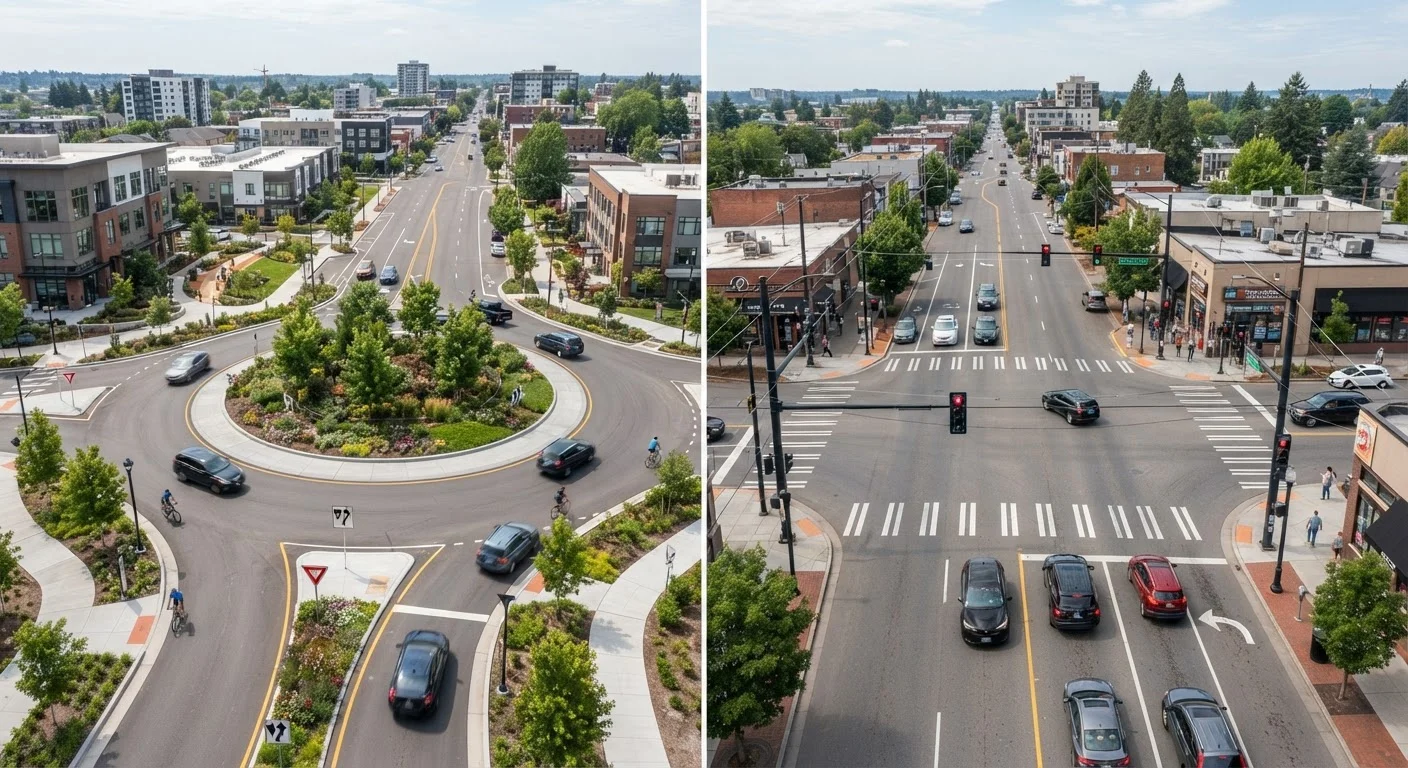
Photo: Online-Searches.net | Explore Insightful Blogs editorial
Key Takeaways
- Roundabouts significantly reduce fatal and serious-injury crashes compared with traditional signalized intersections.
- Traditional intersections handle high traffic volumes efficiently but allow more dangerous right-angle conflict points.
- Driver unfamiliarity with roundabouts — not the design itself — accounts for most of the difficulty people experience.
- The Federal Highway Administration generally supports roundabouts as a safety improvement at appropriate locations.
- Pedestrian and cyclist safety at roundabouts depends heavily on design quality and driver awareness.
The Core Safety Difference
The fundamental reason roundabouts perform so well in safety studies comes down to conflict points — the spots where vehicles can collide. A standard four-way signalized intersection has 32 potential vehicle conflict points, including high-speed right-angle (T-bone) crashes and head-on collisions. A single-lane roundabout reduces that to just 8 conflict points, and crucially, eliminates the right-angle crashes that cause the most serious injuries.
The Federal Highway Administration has documented that converting a traditional intersection to a roundabout can reduce fatal crashes by roughly 90% and injury crashes by around 75%. These figures vary by site and study, but the directional evidence is consistent across multiple independent analyses.
Speed is the other major factor. Vehicles entering a roundabout must slow to roughly 15–20 mph to navigate the curve. At that speed, even a collision produces far less kinetic energy than a broadside impact at 35–45 mph through a green light. This is sometimes called the speed-reduction benefit — it's baked into the geometry itself, not dependent on driver compliance.
| Criterion | Roundabouts | Traditional Intersections |
|---|---|---|
| Vehicle conflict points | 8 (single-lane) | 32 (four-way) |
| Fatal crash risk | Substantially lower | Higher (right-angle crashes) |
| Operating speed | 15–20 mph through curve | Full approach speed possible |
| High-volume capacity | Limited at peak volumes | Strong with coordinated signals |
| Driver familiarity (U.S.) | Lower; learning curve applies | High; deeply familiar |
| Pedestrian accessibility | Variable; design-dependent | Strong with audible signals |
| Fuel efficiency impact | Better (fewer full stops) | More idling at red lights |
Where Traditional Intersections Still Have an Edge
Signal-controlled intersections remain the practical choice in several real-world scenarios. Where traffic volumes are extremely high — think major urban arterials moving thousands of vehicles per hour — coordinated signal timing (called signal progression) can keep traffic flowing in ways a roundabout simply cannot replicate at scale. Multi-lane roundabouts introduce significant driver complexity and can actually increase side-swipe and weaving crashes if not designed carefully.
Emergency vehicle access is also more predictable at signalized intersections, where signals can be pre-empted to clear a path. And for pedestrians with visual impairments, traditional intersections with audible pedestrian signals offer clearer, more standardized cues than the yield-based flow of a roundabout.
It's also worth acknowledging that familiarity matters. Most American drivers have spent decades learning signal timing and four-way stop rules. The unfamiliarity that makes roundabouts feel stressful — especially for older drivers or those in rural areas encountering them for the first time — is a genuine transitional challenge, even if it diminishes with experience. Building calm, defensive habits at any intersection type helps close that gap.
Navigating Roundabouts With Confidence
Most driver confusion at roundabouts stems from two things: who yields and which lane to choose. The rule is straightforward — vehicles already in the circle have the right of way, and entering drivers yield. You do not stop unless traffic inside the circle requires it.
For lane selection in a multi-lane roundabout: if you're turning right or going straight, use the right lane. If you're going straight or turning left (past the 12 o'clock position), use the left lane — and stay in it until your exit. Avoid changing lanes inside the circle; that's where most multi-lane roundabout crashes occur.
~90%
Reduction in fatal crashes at converted sites
The Federal Highway Administration has cited approximately 90% reductions in fatal crashes when traditional intersections are converted to roundabouts, though results vary by location.
8 vs. 32
Conflict points: roundabout vs. four-way intersection
Traffic engineering research establishes that a single-lane roundabout has 8 vehicle conflict points compared with 32 at a conventional four-way intersection.
~75%
Reduction in injury crashes after conversion
Studies reviewed by the Insurance Institute for Highway Safety suggest injury crashes drop by roughly 75% at intersections converted from signals or stop signs to roundabouts.
Approach speed is your friend. Slowing down before you reach the yield line gives you more time to read the gaps in circulating traffic and choose your moment safely. Drivers who treat the entry like a highway merge — accelerating to force a gap — create exactly the conflict roundabouts are designed to prevent. The same spatial awareness that helps with highway merging transfers directly to roundabout entries.
Pedestrians and cyclists deserve special attention. Crosswalks at roundabout exits are set back from the circle itself — slow down and scan before you accelerate out of the roundabout. This is an area where driver inattention, the same problem documented in distracted driving research, creates real hazard for vulnerable road users.
Night Driving and Roundabout Visibility
The content provided on our blog site traverses numerous categories, offering readers valuable and practical information. Readers can use the editorial team’s research and data to gain more insights into their topics of interest. However, they are requested not to treat the articles as conclusive. The website team cannot be held responsible for differences in data or inaccuracies found across other platforms. Please also note that the site might also miss out on various schemes and offers available that the readers may find more beneficial than the ones we cover.