
Long-Term Investing vs. Short-Term Trading

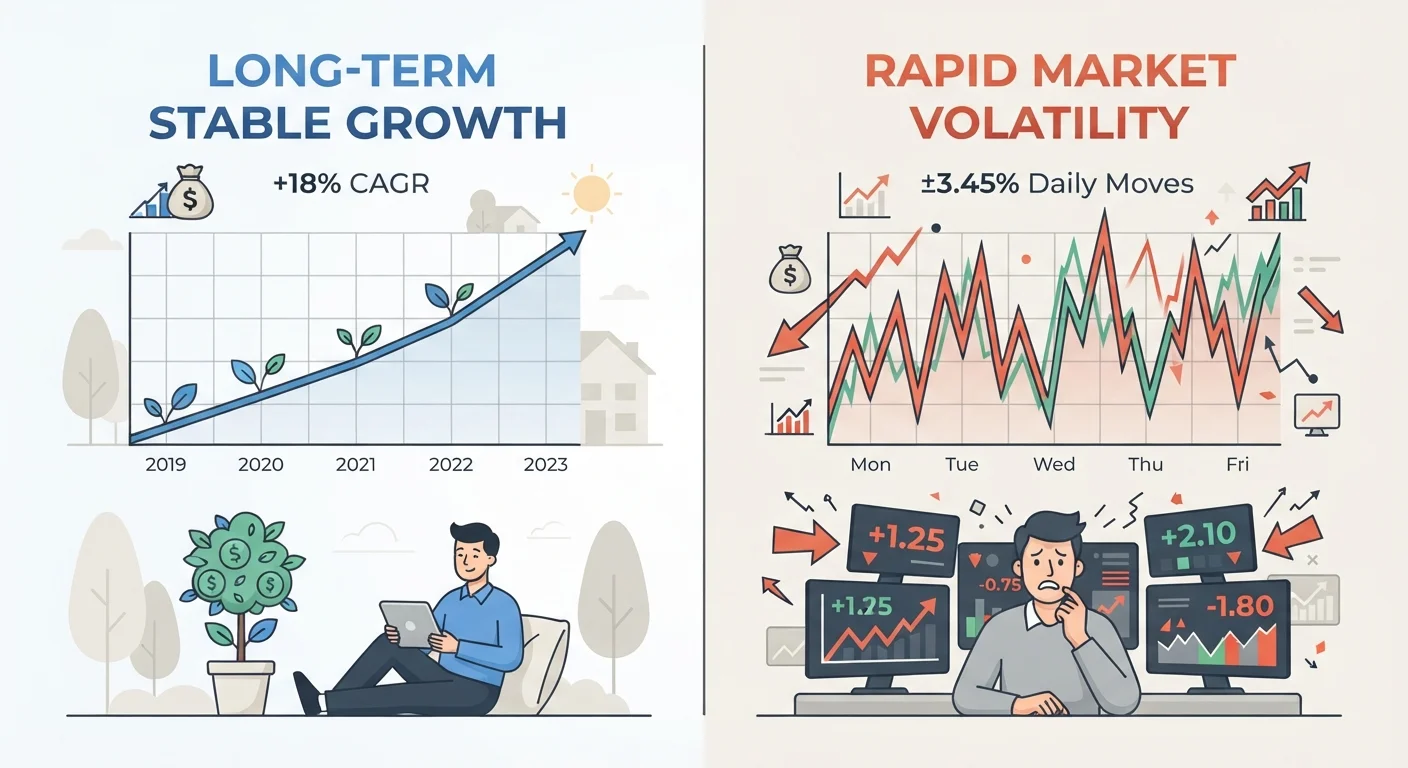
Photo: Online-Searches.net | Explore Insightful Blogs editorial
Key Takeaways
- Long-term investing relies on compounding and time in the market rather than timing the market.
- Short-term trading carries substantially higher risk, costs, and emotional demands than most beginners anticipate.
- Tax treatment differs significantly: long-term capital gains rates are generally lower than short-term rates.
- Research consistently shows that most active traders underperform simple index strategies over time.
- Your investment horizon and risk tolerance — not market excitement — should guide your approach.
What Each Approach Actually Means
Long-term investing means purchasing assets — stocks, bonds, funds, or other instruments — with the intention of holding them for many years, typically a decade or more. The core premise is that markets, despite short-term volatility, have historically trended upward over long time horizons. Investors in this camp lean on compounding (earning returns on previous returns) and minimize trading activity to keep costs and taxes low.
Short-term trading involves buying and selling assets over much shorter windows — anywhere from a single day (day trading) to a few months. Traders aim to profit from price fluctuations rather than the underlying growth of a business or asset. This requires constant market monitoring, rapid decision-making, and a willingness to absorb frequent losses alongside gains.
Understanding the building blocks of a portfolio — stocks, bonds, and funds — is useful groundwork before deciding which approach fits your situation.
A Side-by-Side Comparison
The table below highlights where the two approaches diverge most sharply across practical dimensions every investor should weigh.
| Criterion | Long-Term Investing | Short-Term Trading |
|---|---|---|
| Typical holding period | Years to decades | Days to months |
| Primary goal | Wealth building via compounding | Profit from price fluctuations |
| Capital gains tax rate | Lower long-term rates (0–20%) | Ordinary income rates (up to 37%) |
| Time commitment | Low — periodic review | High — constant monitoring |
| Transaction costs | Minimal — infrequent trades | Significant — frequent trades |
| Emotional demand | Patience through downturns | Rapid decisions under pressure |
| Typical instruments | Index funds, ETFs, diversified portfolios | Individual stocks, options, derivatives |
| Suitability for beginners | Generally well-suited | Generally not recommended |
One dimension the table can't fully capture is psychological demand. Long-term investing requires patience and the ability to ignore short-term market swings without panic-selling. Short-term trading demands near-constant attention, emotional discipline under pressure, and the capacity to accept frequent losses as part of the strategy — a reality many beginners underestimate.
The Tax and Cost Reality
Tax treatment is one of the most concrete and consequential differences between the two approaches. Under current U.S. tax law, profits on assets held longer than one year qualify as long-term capital gains, which are taxed at preferential rates (0%, 15%, or 20% depending on income). Profits on assets held one year or less are taxed as ordinary income — potentially at rates as high as 37% for higher earners.
This means a short-term trader who earns a 10% return may net significantly less after taxes than a long-term investor earning the same nominal return. Trading costs — commissions where they apply, bid-ask spreads, and the compounding drag of frequent transactions — further erode short-term returns.
Long-term investors who use tax-advantaged accounts like 401(k)s and IRAs can shelter gains from taxes entirely until withdrawal (or permanently, in the case of a Roth IRA), a structural advantage that active traders largely cannot replicate.
37%
Maximum short-term capital gains tax rate
Under current U.S. federal tax law, profits from assets held one year or less are taxed as ordinary income, subject to the taxpayer's marginal rate.
~70–80%
Retail day traders who lose money
Multiple academic studies on retail trading activity across different markets have found that the large majority of individual day traders realize net losses over time.
0–20%
Long-term capital gains tax rate range
The IRS taxes gains on assets held longer than one year at preferential rates depending on the taxpayer's taxable income bracket.
Risk, Returns, and What the Evidence Shows
Both approaches carry risk, but the nature of that risk differs. Long-term investors face market risk — the possibility that portfolio values will fall, sometimes sharply, during recessions or corrections. However, holding through downturns has historically allowed investors to recover and grow, provided they stayed diversified and avoided panic-selling.
Short-term traders face all the same market risk, plus execution risk (acting on bad information or faulty timing), liquidity risk, and the compounding effect of transaction costs. Academic research, including studies reviewed by the U.S. Securities and Exchange Commission, consistently finds that the majority of retail active traders lose money over time when compared to passive index strategies.
This connects directly to the relationship between risk and return — higher potential short-term gains come packaged with higher probability of loss. For investors who want a structured, lower-cost way to engage with markets, dollar-cost averaging offers a disciplined middle path that avoids the pressure of market timing entirely.
This article is for general informational and educational purposes only and does not constitute personalized financial, investment, tax, or legal advice. Consult a qualified financial professional before making decisions about your own circumstances.
The content provided on our blog site traverses numerous categories, offering readers valuable and practical information. Readers can use the editorial team’s research and data to gain more insights into their topics of interest. However, they are requested not to treat the articles as conclusive. The website team cannot be held responsible for differences in data or inaccuracies found across other platforms. Please also note that the site might also miss out on various schemes and offers available that the readers may find more beneficial than the ones we cover.