
Index Funds vs. Actively Managed Funds

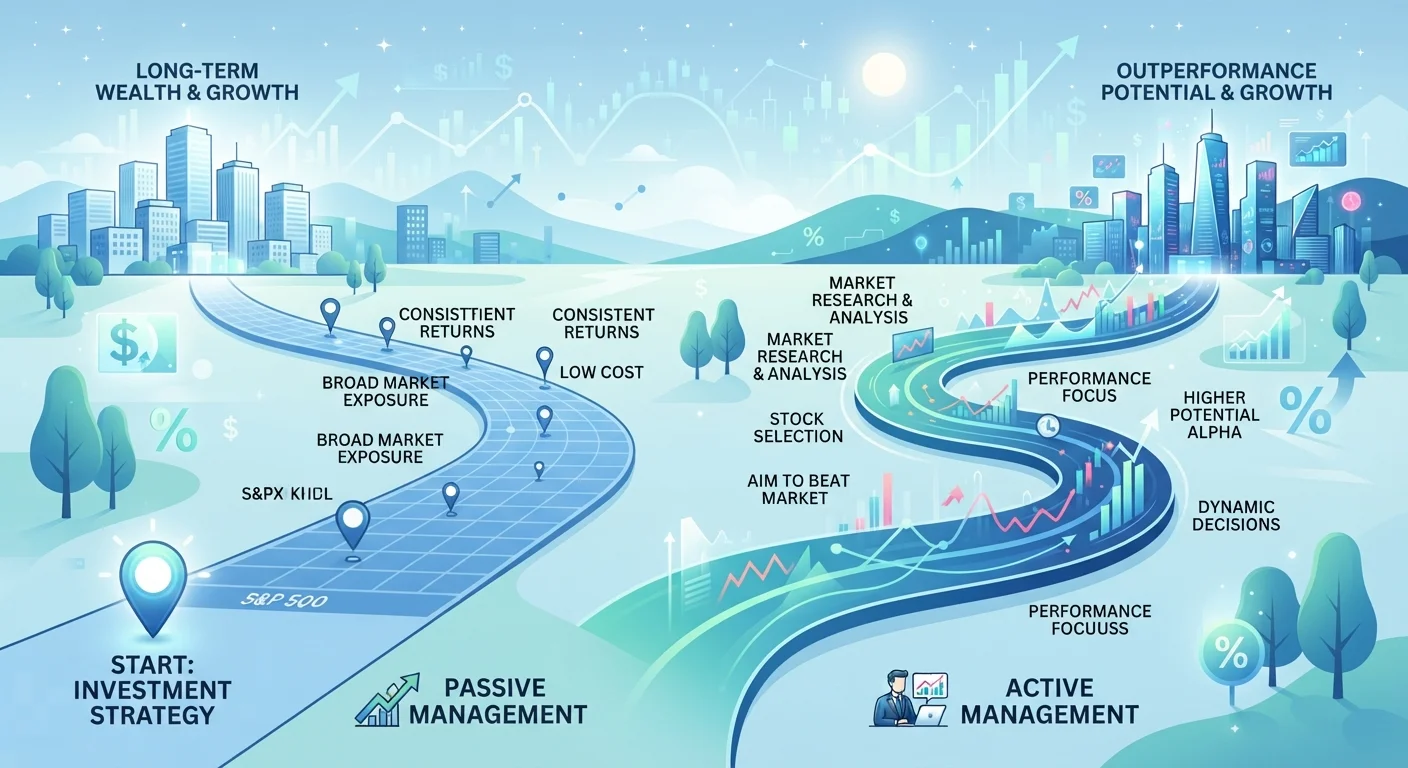
Photo: Online-Searches.net | Explore Insightful Blogs editorial
Key Takeaways
- Index funds passively track a market benchmark; actively managed funds rely on portfolio managers making regular buy and sell decisions.
- Expense ratios for index funds are typically far lower than those for actively managed funds.
- Research consistently shows most actively managed funds underperform their benchmark index over long periods.
- Both fund types can be held inside tax-advantaged accounts like 401(k)s and IRAs.
- Cost, time horizon, and risk tolerance should all factor into which fund type suits your situation.
What Each Fund Type Actually Does
Understanding the difference starts with a simple question: who — or what — is making the investment decisions?
An index fund is designed to replicate the performance of a specific market benchmark, such as the S&P 500 or the Bloomberg U.S. Aggregate Bond Index. A computer algorithm automatically holds the same securities in the same proportions as the chosen index. No manager is predicting which stocks will rise or fall. The fund simply mirrors the market it tracks.
An actively managed fund works differently. A portfolio manager — or a team of analysts — researches securities, makes buy and sell decisions, and attempts to outperform a stated benchmark. This involves ongoing analysis, judgment calls, and frequent trading.
To understand how both fund types fit within a broader portfolio, see our guide to stocks, bonds, and funds.
| Criterion | Index Funds | Actively Managed Funds |
|---|---|---|
| Management style | Passive — tracks a benchmark | Active — manager makes decisions |
| Typical expense ratio | Often below 0.10% | Often 0.50%–1.00%+ |
| Trading frequency | Low — only when index changes | High — ongoing buying and selling |
| Tax efficiency | Generally higher | Generally lower in taxable accounts |
| Goal | Match market returns | Outperform benchmark index |
| Long-term performance track record | Often outperforms most active peers | Majority underperform index after fees |
The Cost Gap and Why It Matters
One of the most significant practical differences between these two fund types is cost, measured by the expense ratio — the annual percentage of your invested assets charged to cover fund operating costs.
Index funds routinely carry expense ratios well below 0.10% annually. Many broad-market index funds charge even less. Actively managed funds, by contrast, often charge between 0.50% and 1.00% or more, reflecting the salaries of analysts, research costs, and higher trading activity.
~0.05%
Typical index fund expense ratio
Many broad-market index funds available to U.S. investors carry expense ratios at or below this level, according to industry data.
80%+
Active U.S. equity funds underperforming over 15 years
S&P Dow Jones Indices' SPIVA reports have consistently found the majority of active U.S. large-cap equity funds trail the S&P 500 over 15-year periods after fees.
~0.65%
Typical actively managed fund expense ratio
Investment Company Institute data indicates average expense ratios for actively managed U.S. equity funds have historically ranged between 0.50% and 1.00%.
That gap may sound small in a given year, but over a 20- or 30-year investing horizon, compounding means a higher expense ratio can reduce your ending balance by tens of thousands of dollars, depending on your investment amount. This cost drag is one reason many financial educators highlight low-cost investing as a core discipline — a principle explored in our article on habits that tend to serve long-term investors.
Performance: What the Evidence Shows
Proponents of active management argue that skilled managers can identify opportunities the market hasn't priced in, justifying higher costs. The empirical track record, however, is challenging for that argument.
Long-running reports from S&P Dow Jones Indices — known as the SPIVA Scorecards — have found that the majority of actively managed U.S. equity funds underperform their benchmark index over 10- and 15-year periods, after fees. This doesn't mean active managers never outperform; some do, in some periods. But sustaining that outperformance consistently, and after costs, has proved difficult.
It's worth noting that performance patterns vary by market. Active managers have historically found it harder to beat highly efficient markets — like large U.S. company stocks — where information is widely available and prices reflect it quickly. Some research suggests active management may add more potential value in less-liquid or less-covered segments, though results remain mixed.
Past Performance Does Not Predict Future Results
This is general financial information, not personalized investment advice. Consider consulting a licensed financial adviser before making fund decisions specific to your situation.
Tax Efficiency and Account Considerations
Actively managed funds typically trade more frequently, which can generate capital gains distributions — taxable events passed on to shareholders, even if you didn't sell your shares. Index funds, with their lower turnover, generally produce fewer of these distributions, making them more tax-efficient when held in a taxable brokerage account.
Inside tax-advantaged accounts like a 401(k) or IRA, capital gains distributions are deferred or eliminated, reducing this distinction. Still, cost differences and performance considerations remain regardless of account type.
Pairing either fund type with consistent contributions over time — a strategy called dollar-cost averaging — can help reduce the impact of short-term market volatility on your overall returns.
How to Think About Your Own Decision
There is no universal answer to which fund type is right for every investor. What matters is aligning your choice with your goals, timeline, and cost sensitivity.
For many everyday investors, particularly those just starting out, index funds offer an accessible, low-cost way to participate in broad market growth while maintaining meaningful diversification. For investors with specific goals — income generation in a niche bond market, for example — a carefully selected actively managed fund might serve a role in a larger portfolio.
Whether you lean toward passive or active strategies, understanding the difference between long-term investing and short-term trading will help you stay focused on what actually drives wealth-building over time: consistency, cost awareness, and patience.
This article is for general informational and educational purposes only and does not constitute personalized investment, tax, or financial advice. Consult a qualified financial professional before making investment decisions.
The content provided on our blog site traverses numerous categories, offering readers valuable and practical information. Readers can use the editorial team’s research and data to gain more insights into their topics of interest. However, they are requested not to treat the articles as conclusive. The website team cannot be held responsible for differences in data or inaccuracies found across other platforms. Please also note that the site might also miss out on various schemes and offers available that the readers may find more beneficial than the ones we cover.