
What Lawn Soil Is Actually Telling You

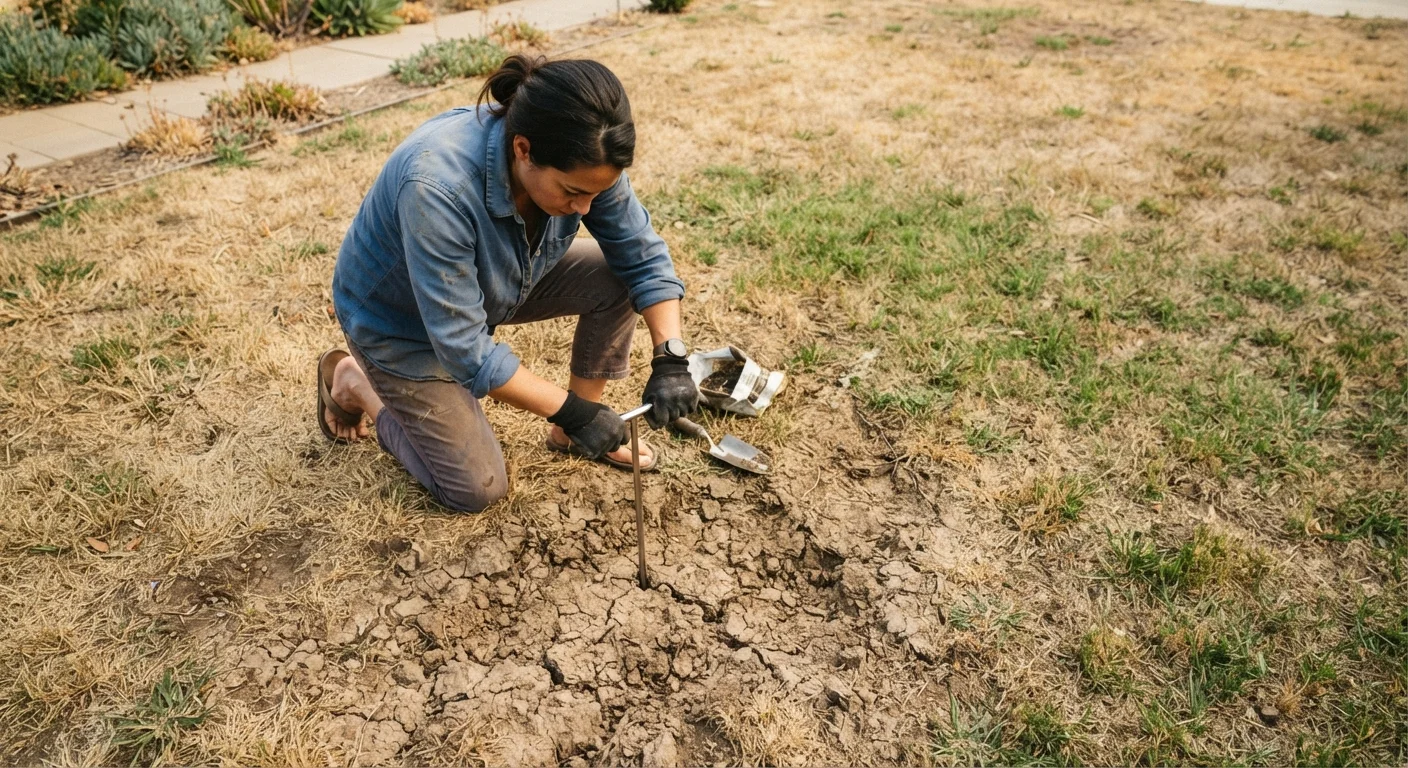
Photo: Online-Searches.net | Explore Insightful Blogs editorial
Key Takeaways
- Compacted soil, puddles, and bare patches are diagnostic signals, not just aesthetic problems.
- A simple soil probe or screwdriver test can reveal compaction without any special equipment.
- Soil pH directly controls how well grass can absorb nutrients, even when fertilizer is applied.
- Heavy clay and sandy soils create opposite problems but both benefit from added organic matter.
- Aeration and compost topdressing address most common soil structure issues over time.
Reading the Signs Your Soil Is Sending
Most lawn problems that look like grass problems are actually soil problems in disguise. Thin turf, yellow patches, and poor growth after fertilizing are frequently symptoms of what's happening underground — not above it. Learning to read those signals shifts you from treating symptoms to solving causes.
Soil communicates through a handful of consistent patterns. Recognizing them takes no special tools and no laboratory — just observation and a few simple field checks.
- Water pools after normal rain: Water that sits on the surface for 30 minutes or more after a moderate rain suggests the soil beneath can't accept it. Compaction or heavy clay is usually responsible.
- Grass thins in high-traffic areas: Paths across the lawn, spots near gates, or areas near driveways that consistently go bare point directly to compacted soil — foot traffic squeezes out the air pores roots depend on.
- Fertilizer doesn't seem to work: When grass stays pale or weak despite regular feeding, the issue is often pH. Soil that's too acidic or too alkaline locks nutrients into chemical forms roots can't access. See our guide to fertilizer and soil health for a deeper look at how nutrients interact with soil chemistry.
- Soil cracks when dry: Visible cracks in dry conditions indicate very low organic matter and often a high clay or silt content that shrinks dramatically as moisture leaves.
The Three Dimensions of Soil Health
Soil health isn't a single measurement — it operates across three interconnected dimensions, each of which can independently limit how well your grass grows.
Structure
Soil structure describes how mineral particles are arranged and how much pore space exists between them. Good structure means roughly equal parts solid material, water-filled pores, and air-filled pores. Compacted soil collapses that air space, restricting root growth and water infiltration. The screwdriver test is the simplest field check: push a standard screwdriver into moist soil. It should slide in with moderate hand pressure to at least four inches. Significant resistance before two inches indicates compaction worth addressing.
Chemistry
Soil chemistry governs nutrient availability, and pH is its master dial. Most lawn grasses thrive between 6.0 and 7.0 on the pH scale. Below 6.0, nutrients like phosphorus and calcium become less available; above 7.0, iron and manganese are often locked out. A basic soil test — available through most state university cooperative extension services — reveals pH and primary nutrient levels. It's the single most actionable data point a homeowner can get. If you're seeing unexplained thin or yellow grass, pH is often the first thing worth ruling out.
Biology
Healthy soil is alive. Earthworms, fungi, and billions of bacteria break down organic matter, cycle nutrients, and maintain soil structure. Overuse of certain pesticides, soil compaction, and very low organic matter all reduce biological activity. Organic matter percentage — ideally 3–5% for lawn soils — is the key driver of a thriving soil ecosystem.
6.0–7.0
Ideal soil pH range for most lawn grasses
According to university cooperative extension guidance, most cool- and warm-season turf grasses perform best within this slightly acidic to neutral pH window.
3–5%
Target organic matter content for healthy lawn soil
Soil scientists generally cite this range as optimal for supporting microbial activity, nutrient cycling, and soil structure in residential lawn settings.
4 inches
Minimum screwdriver penetration depth indicating healthy soil
The screwdriver field test, widely used by lawn care professionals, uses this depth as a practical benchmark for ruling out significant compaction.
Common Soil Types and What They Mean for Your Lawn
Soil texture — the ratio of sand, silt, and clay particles — shapes almost everything about how your lawn behaves. Most American lawns fall somewhere on a spectrum between clay-heavy and sandy, with each extreme creating predictable challenges.
Clay-Heavy Soil
Clay particles are microscopic and pack tightly, which is why clay soils drain slowly, compact easily under foot or mower traffic, and form a hard crust when dry. The upside: clay holds nutrients well. The challenge is getting water and air in. Core aeration followed by compost topdressing is the standard long-term approach. Our explainer on lawn aeration timing and methods covers how to choose the right technique for your soil type.
Sandy Soil
Sandy soils drain fast — sometimes too fast. Water and nutrients move through before roots can use them, leading to drought stress and chronic nutrient deficiency even with regular watering and feeding. If you're noticing your lawn dries out unusually quickly, check our lawn watering guide to adjust your irrigation habits alongside soil improvement.
Loam
Loam — a balanced mix of sand, silt, and clay — is the gold standard. It drains well, holds nutrients, and supports root penetration. If you're starting from degraded or builder's fill soil, building toward loam-like conditions through organic matter additions is the practical goal. See our guide to seeding a new lawn for how soil preparation fits into a full lawn-building plan.
Start With a Soil Test Before Amending
What to Do Once You Understand What's Wrong
Diagnosis is only useful when it leads to action. Once you've identified which soil signal your lawn is sending, the response options are fairly straightforward.
- Compaction: Core aeration — removing small plugs of soil — is the most effective physical remedy. Timing matters: cool-season grasses benefit most from fall aeration, warm-season grasses from late spring into early summer.
- pH imbalance: Lime raises pH in acidic soils; elemental sulfur lowers it in alkaline soils. Always base applications on a soil test result rather than guessing — adding lime to soil that doesn't need it can create new problems.
- Low organic matter: A quarter-inch layer of finished compost raked into the lawn after aeration feeds soil biology and gradually improves structure. This is one of the highest-return investments in lawn care, with effects that build season over season.
- Drainage problems in clay: Topdressing with compost over several seasons is the surface-level approach. Severe drainage problems in low spots may require grading or a French drain — work that benefits from a landscape professional's assessment before digging.
Most soil improvement is slow, cumulative work. A lawn built on good soil practices — aeration, organic matter, and pH management — generally needs less fertilizer, water, and intervention over time. Understanding what your soil is actually telling you is the foundation that everything else rests on. For a seasonal checklist that puts these soil principles into practice, see our spring lawn prep guide.
Frequently Asked Questions
The content provided on our blog site traverses numerous categories, offering readers valuable and practical information. Readers can use the editorial team’s research and data to gain more insights into their topics of interest. However, they are requested not to treat the articles as conclusive. The website team cannot be held responsible for differences in data or inaccuracies found across other platforms. Please also note that the site might also miss out on various schemes and offers available that the readers may find more beneficial than the ones we cover.